


Walk past enough entrances and a pattern starts to emerge. Some feel settled the moment you see them, as though the greenery has always belonged there. Others, despite healthy plants and handsome outdoor planters, read as a handful of unrelated objects that arrived on the same afternoon.
The difference is rarely how many plants there are or what the planters cost. It is the relationship between them. Good planting composition is about relationships, not quantity: plants and planters of different heights, sizes, shapes, and visual weights, positioned so the eye knows where to land, where to travel next, and where to rest. Designers call this plant hierarchy, and once you can see it, you will notice it everywhere.
What Hierarchy Means in a Plant Installation
In landscape design, hierarchy is a clear visual order between elements, from entrance landscaping to wider garden design. When every plant matches in height, scale, density, and intensity, an arrangement feels flat, repetitive, or disconnected. The eye has nothing to follow, so it slides past. Deliberate variation gives it a route.
Most successful compositions assign three broad visual roles:
- Dominant element: the plant or planter that draws attention first and sets the focal point.
- Secondary elements: medium-scale plants that support the dominant feature and create a transition away from it.
- Supporting elements: smaller or more delicate plants that add detail and keep the composition continuous.
One clarification matters. Hierarchy is not about making one plant better or more important than the others. It is about giving every element a clear visual role. A low, feathery plant isn’t less than a tall specimen; it simply has a different job.
How Landscape Hierarchy Is Created
Five variables do most of the work: height, scale, form, visual weight, and repetition.
1. Height
Height is the simplest way to establish order, and the progression is easy to picture: tall, then medium, then low.
Imagine approaching an entrance, courtyard, driveway or terrace. A tall plant or small tree sets the dominant vertical layer, and you register it from a distance. Medium-height plants carry your eye downward, and lower planting completes the base. Without that stepping, a line of same-height planters reads like a row of identical objects. With it, the eye moves.
2. Scale
Plant scale and planter scale have to work together. A substantial plant in a generously sized planter can act as the primary anchor, while smaller architectural planters and their plants support it without competing.
Scale matters most in large architectural entrances, commercial facades, driveways, open outdoor areas, and large residential properties, where the setting can swallow a timid arrangement. An undersized installation disappears against large architecture; an oversized one overwhelms a smaller space. Good planter design responds to the proportions around it. A few visual cues help:
- Does the planting still register from the gate or road, not just from the door?
- Does the largest planter feel proportionate to the door, column, or facade behind it?
3. Form
Plants have visual personalities, and their forms shape hierarchy:
- Upright, architectural forms
- Rounded, sculptural forms
- Broad, leafy forms
- Spiky, highly structural forms
- Soft, flowing forms
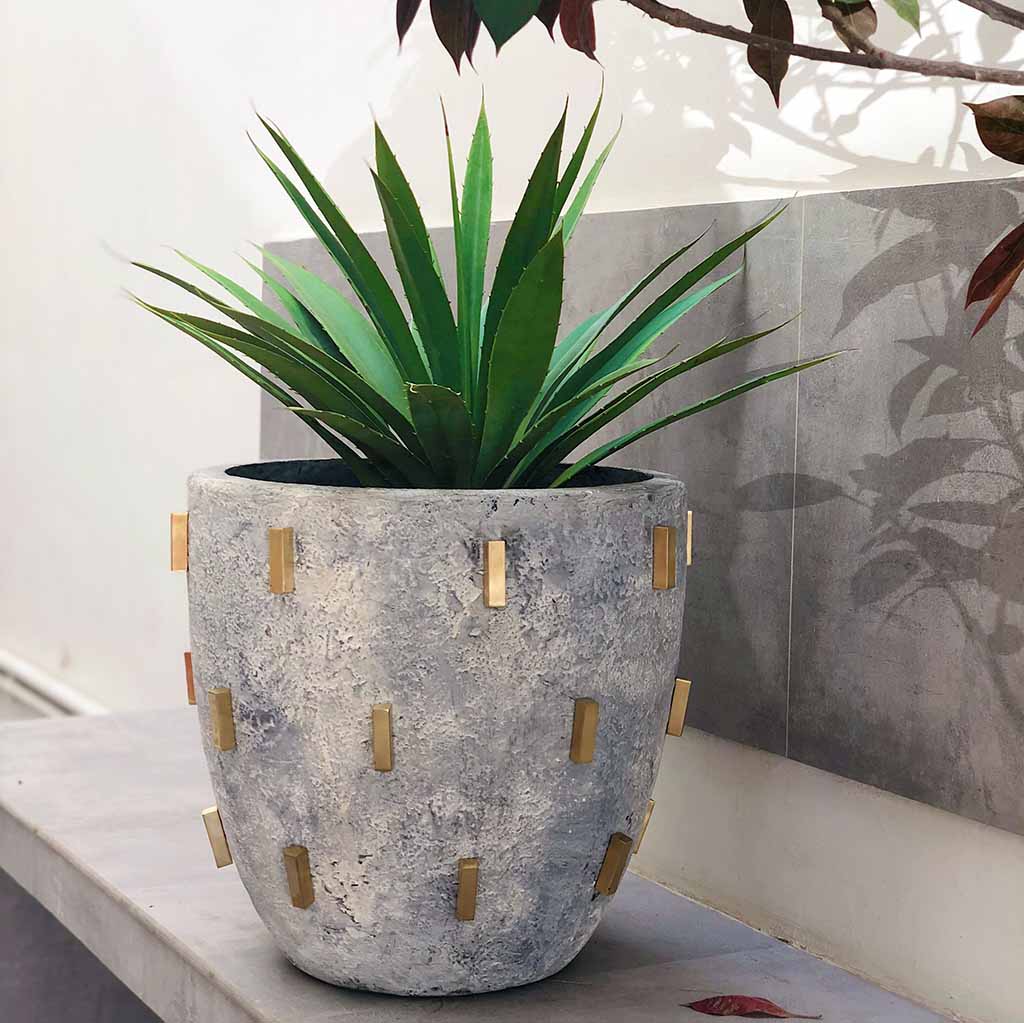
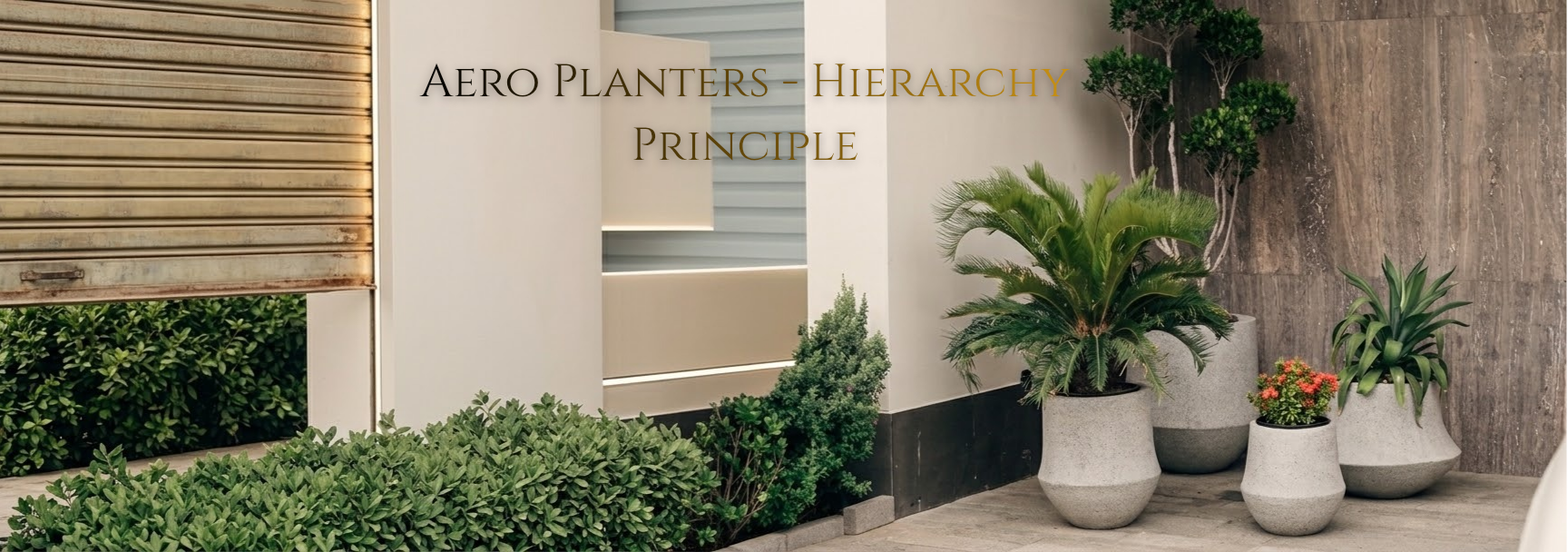
Contrast is where interest comes from. An architectural plant looks sharper beside softer foliage, while a rounded plant can bridge the gap between a tall specimen and lower planting. The Agave in CREO’s client installation shows this well. Its structured form adds character and definition without requiring every plant around it to compete. Because it speaks clearly, its neighbours can stay quieter.
4. Visual Weight
Plants do not all demand the same attention. A plant carries more visual weight when it is dense, darker in tone, larger, more strongly structured, or more distinctive. Delicate, airy foliage carries far less.
Hierarchy distributes that weight intentionally. The goal is not simply placing attractive plants side by side, but preventing one side of the installation from feeling disproportionately heavy. Visual balance can exist even when physical sizes or quantities differ: a single dense, dark planting can be balanced by several lighter, more open ones.
5. Repetition and Rhythm
Hierarchy does not mean every element must be different. Repeating certain forms, planter finishes, or materials creates rhythm and continuity. Several planters might share a finish while the plants inside vary in height, density, and form. Repetition gives the composition a visual language; variation keeps it from turning monotonous.
The strongest installations combine consistency and contrast rather than choosing one over the other.
A Real Installation, Read Through Hierarchy
In CREO’s recent client installation, these principles are visible at a glance. The larger, taller planting establishes the main visual anchor. Medium-height plants create a transition away from it, easing the eye downward. Smaller, more delicate plants add detail and soften the lower part of the composition. The Agave introduces a strong architectural form and another layer of character.
Differences in planter size and planting form create height, depth, variation, rhythm and visual movement. Nothing is simply placed beside something else. Position and proportion let the elements work as one composition, which is why the result feels intentional rather than assembled.
Hierarchy Is Not Symmetry
It is tempting to assume balance means mirror images, such as two identical planters flanking a door. Symmetry has its place, but hierarchy and symmetry are not the same thing. A sophisticated planting arrangement does not need to be symmetrical to feel balanced.
Asymmetrical balance works through visual weight:
- One large planter balanced by several smaller ones
- A tall plant on one side counterbalanced by greater plant density on the other
- A strong architectural plant balanced by softer foliage elsewhere
The objective is not mathematical symmetry. It is visual balance. Asymmetrical arrangements often feel more organic and more connected to architecture, because buildings are rarely perfect mirrors and the eye enjoys resolving a composition.
Planting That Belongs to the Architecture
Plant hierarchy should respond to the building around it. A large entrance or commercial facade may need taller, more substantial planting. A narrow entrance often benefits from a stronger vertical composition. A smaller residential entry calls for more controlled scale, while an open driveway or large architectural setting may need greater variation in height and volume.
In commercial landscaping and residential landscaping alike, the aim is that the installation feels as though it belongs to the architecture rather than simply being placed in front of it. Planter arrangement should respond to:
- Architectural proportions
- Available space
- Circulation
- Sightlines
- Entry points
- The character of the surrounding building
Planting can frame, soften, reinforce or complement architectural forms.
How CREO Approaches the Complete Composition
CREO looks beyond the individual planter to the whole composition. Customers may know they want more greenery or a stronger entrance, but not which planter size to choose, which plants work well together, how many planters are appropriate, which should be taller or shorter, or how the planting should relate to the architecture. A landscape consultation brings those decisions together.
The principle is simple: the planter is the foundation, and plant selection and arrangement create the composition. For AERO installations, CREO can help with planter selection, plant selection, positioning and installation, so the finished result feels considered, cohesive and purposeful rather than improvised.
The Final Takeaway
Good landscape design isn’t about having more plants. It’s about giving each plant a role.
Some plants establish height. Some create volume. Some provide colour. Some soften the composition. Some become the focal point. When those roles are deliberately arranged, the result feels balanced, intentional, and visually complete.
That is hierarchy at work: not a ranking of plants, but an arrangement in which each one adds to the whole.
Browse the CREO Living website for luxurious gifting pieces, home decor, furniture, lamps, and serveware accessories made to be lived with. Find the piece that gives your space, or someone else’s, its own considered role.
FAQs
1. What is hierarchy in landscape design?
A: It is a clear visual order among plants and planters. Different heights, scales, forms, and visual weights give each element a role, so the eye knows where to look first and how to move through the space. It turns a group of plants into a composition with a focal point.
2. How do you create hierarchy in a planter arrangement?
A: Start with one dominant plant or planter as the anchor, then add medium-height plants to transition downward and smaller plants for detail. Vary height, form, and volume, but repeat a planter finish or material so the whole arrangement still feels cohesive.
3. Can an asymmetrical planting arrangement still look balanced?
A: Yes. Balance comes from visual weight, not mirror images. One large planter can be offset by several smaller ones, or a tall plant can be balanced by denser planting on the other side. Asymmetry often feels more natural and sits more comfortably with architecture.
4. How do plant and planter scale affect entrance landscaping?
A: Scale decides whether planting is noticed or overlooked. Small planters vanish against a large facade, while oversized ones crowd a modest entry. Match scale to the door, the building’s proportions, and the walking space, so the greenery frames the entrance rather than competing with it.