The Unseen Architecture of Geometry
Every tablescape has a skeleton, even if no one notices it directly. It lives in the risers, platforms, and pedestals that hold your desserts aloft, the quiet architecture beneath the icing sugar and gold leaf. Most hosts default to round shapes without a second thought, and round is lovely. But treating your dessert display as a genuine architectural exercise means asking a sharper question: what does this particular shape do to the room’s feeling?
A square edge reads differently than a soft curve. A shallow saucer casts a different shadow than a tall pedestal. Once you start styling with shape as your primary design tool, not just height, not just color, your table stops being a collection of plates and becomes a composition. This is where genuinely luxury cake stands Pakistan hosts are gravitating toward come in: pieces chosen not merely for material, but for the geometric statement they make.
Architectural Precision: Square and Rectangular Platforms
If your drawing room leans contemporary, clean sightlines, minimal ornamentation, a restrained palette, square and rectangular risers are your strongest ally. Straight edges introduce order. They create visual rest stops across a table that might otherwise feel busy, and they pair exceptionally well with desserts that already have architectural form.
Rectangular platforms are particularly suited to:
- Structured layer cakes with sharp, unfrosted edges (naked cakes, geometric buttercream finishes)
- Rows of uniform petit fours or macarons, where the linear frame reinforces the repetition
- Canapé-style savory pairings for hybrid high tea and cocktail spreads
- Minimalist events, engagement teas, corporate gifting showcases, where restraint is the aesthetic goal
The trick with linear risers is spacing discipline. Because the eye reads straight lines quickly, overcrowding a rectangular stand collapses the very order you’re trying to create. Leave breathing room at the corners. A rectangular platform styled with generous negative space feels considered; one packed edge-to-edge feels merely functional.
Enduring Grace: The Classic Round Pedestal
There’s a reason the round pedestal has never gone out of style in Pakistani entertaining, it belongs here. Circular silhouettes echo the domes, arches, and rounded motifs woven through much of our traditional architecture and textile pattern work. A round cake stand Pakistan hosts have relied on for generations doesn’t just hold a dessert; it softens an entire tablescape.
Curves have a functional advantage too: they read equally well from every angle. At a large shaadi or milad gathering, where guests circle the table rather than sit at fixed points, a round pedestal never presents an “ugly side.” Its silhouette also tempers the hard geometry of rectangular dining tables and buffet counters, introducing a visual exhale between straighter lines elsewhere in the room.
Round stands excel with:
- Layered wedding cakes and traditional multi-tier centerpieces
- Warm, heritage-toned interiors, brass, mirror work, jewel-toned linens
- Gatherings where guests will approach the display from all sides
Shallow Saucers & Low Profiles: Displaying Flat Arrangements
Not every dessert wants height. Stuffed dates, baklava, fresh figs, and delicate petit fours often perform best when they’re allowed to spread out rather than stack up, and this is where shallow saucer stands and low-lipped platforms earn their place in a serious styling kit.
A tall pedestal beneath a flat arrangement creates an awkward visual gap: too much negative space beneath the food, too little around it. A shallow saucer solves this instantly. Its low profile frames flat, textured desserts the way a gallery frame frames a painting, present, but never competing for attention.
Use shallow profiles when you want to:
- Display an assortment where variety, not verticality, is the point
- Keep sightlines open across a low coffee table or majlis-style seating arrangement
- Add a resting note between taller risers so the eye has somewhere to pause
The Art of the Mix: Combining Shapes Without Material Chaos
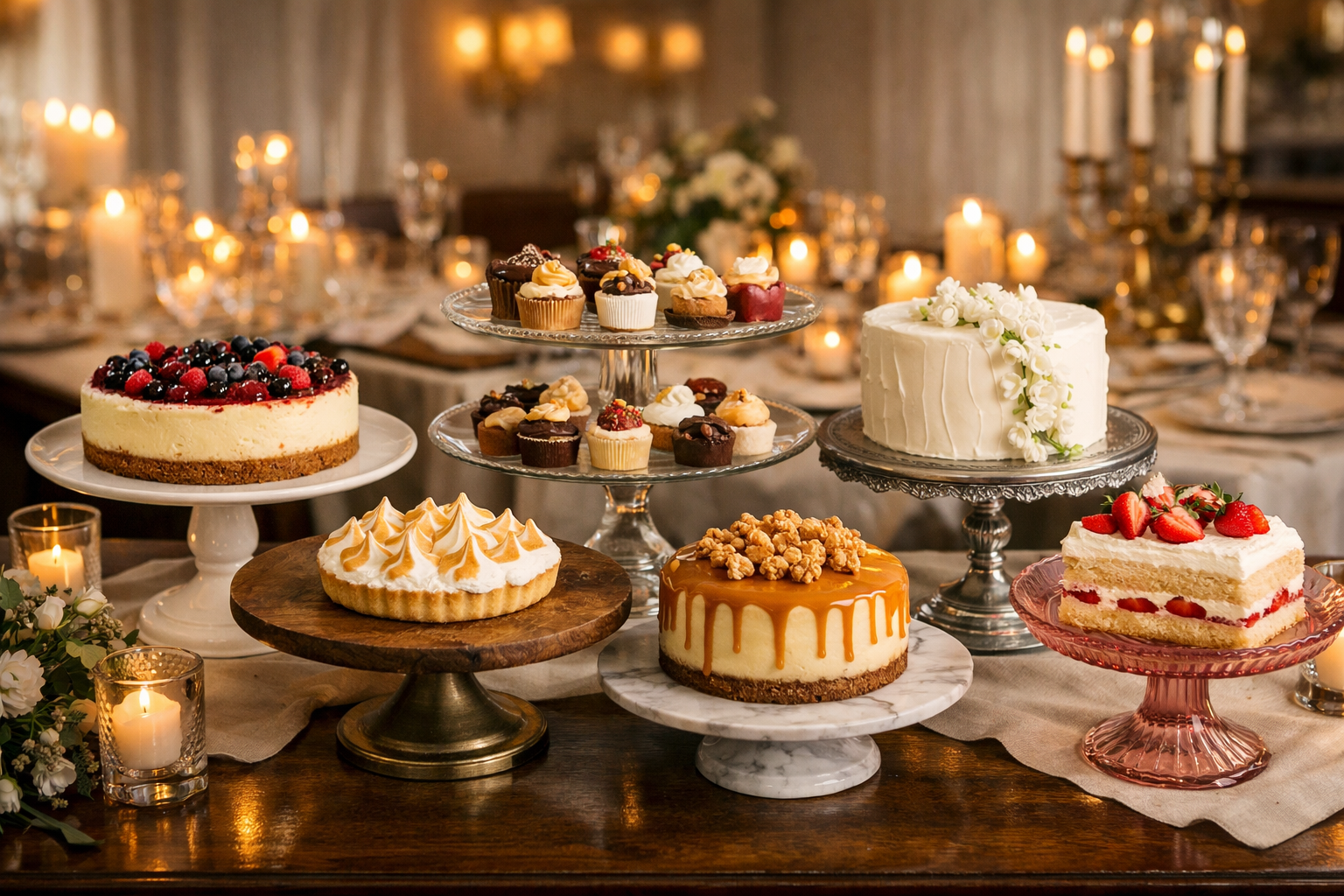
The most sophisticated tablescapes rarely rely on a single shape. They layer square, round, and tiered forms together to create genuine dimensionality, peaks and valleys the eye can travel through rather than a flat, uniform row of identical stands.
But mixing shapes is only elegant when you follow one governing rule: material consistency. Vary the geometry as much as you like, but keep the material language singular. All brass, all marble, all lacquered wood, whatever your foundation, let it repeat across every shape on the table. This is the difference between an intentional architectural mix and a table that simply looks unplanned.
A dependable framework for building a mixed layout:
- Anchor first. Start with your tallest piece, often a 3-tier cake stands for desserts arrangement, positioned slightly off-center rather than dead-center, to avoid a static, symmetrical feel.
- Flank with contrast geometry. Place a square or rectangular platform on one side of the anchor and a round pedestal on the other, so no two adjacent shapes repeat.
- Ground the composition. Finish with a shallow saucer near the front edge, closest to guests, so the display steps down toward the viewer rather than looming over the table.
- Repeat the material, not the silhouette. Every piece should feel like it belongs to the same family, even though no two share an outline.
When you shop with this framework in mind, it becomes far easier to buy cake stands online in Pakistan with intention rather than impulse, selecting pieces that will genuinely combine, rather than accumulating stands that fight each other on the table.
Elevate every gathering with Creo Living’s curated collection of premium serveware, lamps, and home accessories, built to turn a simple table into a considered composition. Bring home pieces designed for hosts who see design in every detail, shop the full collection today.
FAQs
Q: How many different cake stand shapes should I use on one table?
A: Two to three is the sweet spot. A single anchor shape, one contrast geometry, and optionally a low saucer for grounding gives you dimension without visual clutter.
Q: How do I keep a mixed-shape table from looking unbalanced?
A: Stagger heights and offset your tallest piece from the table’s center, then distribute smaller stands unevenly around it, true symmetry often reads as stiff rather than styled.
Q: What’s the best way to care for brass or marble cake stands?
A: Brass should be hand-polished with a soft cloth and kept away from prolonged moisture; marble benefits from a mild pH-neutral cleaner and should never sit under acidic fruit syrups for extended periods without a liner.
Q: What should I consider before purchasing cake stands in Pakistan?
A: Think beyond the single event, consider whether the shape, material, and scale will suit your existing serveware and future gatherings, since a well-chosen stand should outlast any one occasion.